SEISMIC TECHNOLOGY: SEISMIC DETECTION (VIBRATIONS/SOUNDS) OF BURIED VICTIMS
SEARCH devices are ultra-sensitive seismic sensors (also called 'listening equipment' or 'listening device') designed to detect and locate victims buried under rubble following a catastrophe. It is used during the technical search phase of USAR search and rescue-clearance operations.
SEARCH seismic detectors use seismic technology. These are wave receivers. When a person moves, scratches, shouts, taps, etc., they create vibrations that resonate and travel in the various construction materials of the collapsed building and the control box amplifies them. In this way the rescuer can 'listen' using an audio headset and 'observe' the audio signal using bar graphs on the control box.
Seismic sensors detect the vibrations (waves) emitted by a person trapped under the rubble with an unobstructed range of 100 m! In this way they enable living victims to be located geographically under wreckage.
SEISMIC SENSORS DEVELOPED FOR THE FIELD
Compact and lightweight (690 g), this listening equipment fits easily into a pocket. They are sealed (IP67) and can withstand damp conditions and rain. They also have a flexible aerial (ensuring optimum connectivity) and a carrying strap (making them easier to position and carry).
A LED button indicates from a distance that the sensors are correctly connected to the box. SEARCH seismic sensors are available in wireless and cabled versions. Both sensor versions have the same listening performance.
Wireless sensors: Being wireless, they have no cables. So there's no problem dealing with cables trapped in the rubble. And they can be deployed very quickly. They have an unobstructed range of 100 m and around 30 m in the field depending on the obstacles. They have 8 hours running time. 3 sensors can be connected at the same time.
Cabled sensors each have 8 m of cable for an operating radius of 24 m, powered directly by the control box by cable. 3 sensors can be connected at the same time as 3 other wireless sensors on the LEADER SEARCH MONO-APP box, making a total of 6 sensors.
SEARCH devices can be connected to control boxes as follows:
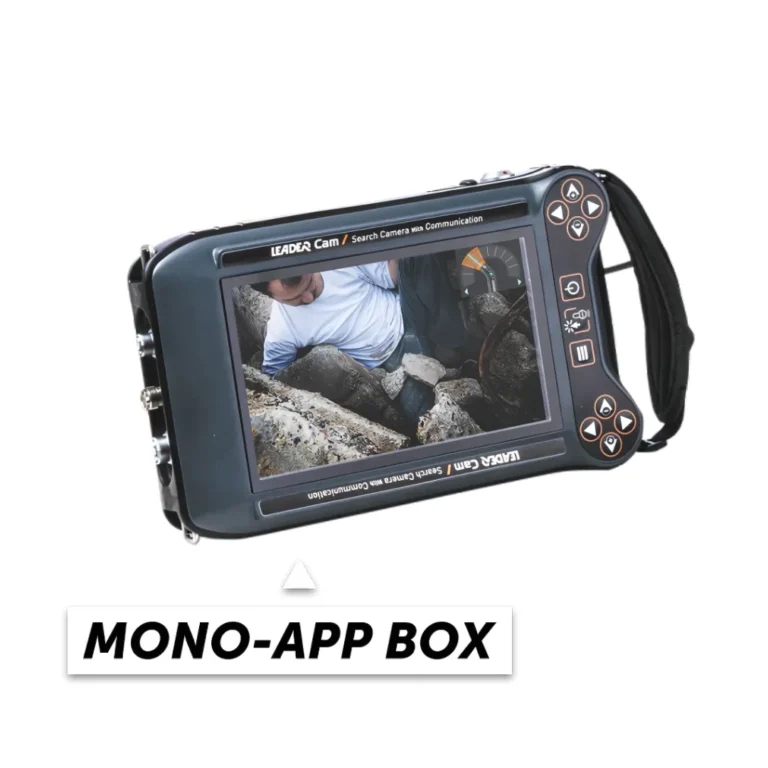
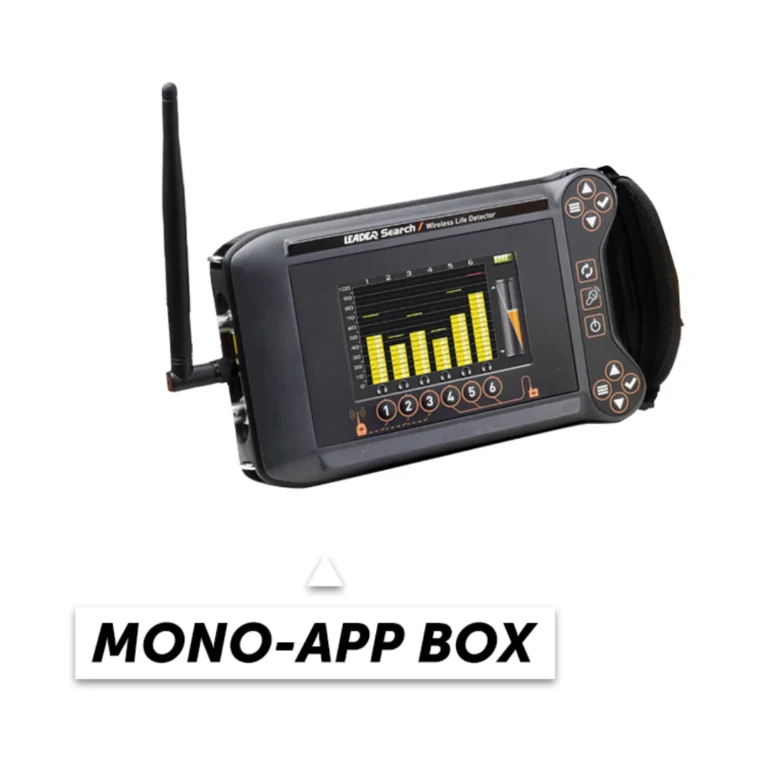
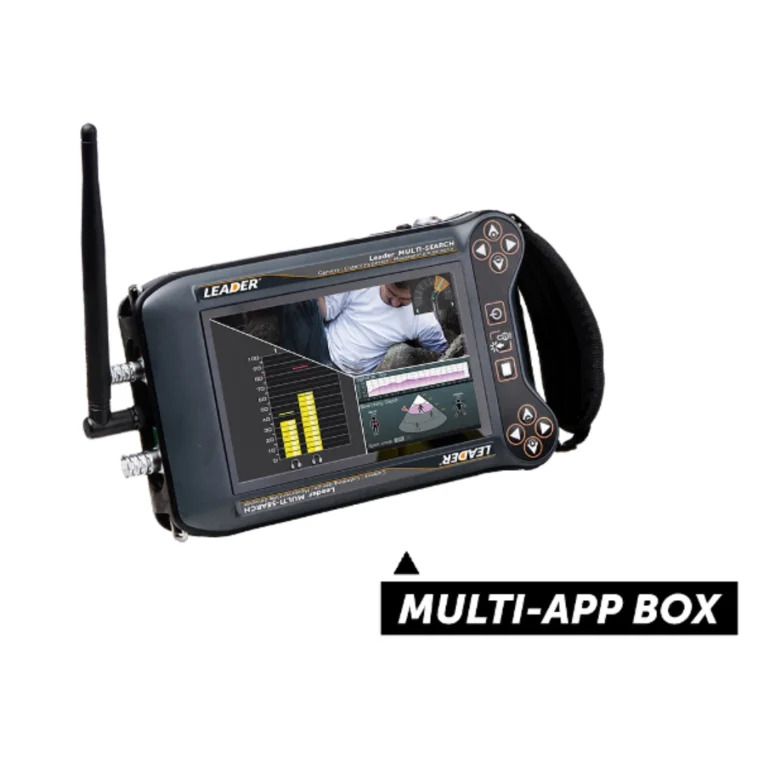
- Wireless sensors: can be connected to MULTI-APP boxes (LEADER MULTISEARCH, CAM MS, SEARCH MS, HASTY MS and SCAN MS devices) or MONO-APP control boxes (LEADER SEARCH and HASTY devices). 1 to 3 sensors can be connected at the same time.
- Cabled sensors: can only be connected to the MONO-APP box (LEADER SEARCH devices). 1 to 3 sensors can be connected at the same time in addition to 3 wireless sensors that might already be connected.
ADJUSTABLE NOISE FILTERS
By using noise filters, it is possible to eliminate interfering high- and low-pitched noise coming from pneumatic drills, rescue vehicles, the wind, cables, etc. Two possible listening modes: Mono and Stereo modes to listen to selected sensors in one or both ears, allowing a wide variety of listening combinations.
USER-FRIENDLY GRAPHIC INTERFACE
Each item has been designed to make rescuers' work easier:
- Compact and lightweight control box,
- Extra-wide colour screen,
- User-friendly graphic interface,
- Intuitive menu,
- Adjustment of noise filters,
- Mono or Stereo listening mode,
- Individual listening to each seismic sensor,
- Display trackers to identify the highest seismic peak,
- Charge level indicator for wireless seismic sensors,
- Push-to-Talk via the communication probe (MONO-APP box only)
SEARCH devices are wireless or cabled seismic sensors (also called 'listening equipment', 'listening systems' or electronic search and rescue devices) to detect and locate buried victims developed with victim location specialists.
These seismic sensors are used during urban search and rescue operations to detect conscious buried victims and accurately locate their position under wreckage. The seismic technology used in SEARCH sensors helps detect the smallest vibration caused by a conscious victim: scratching, knocking, voice, etc. even in the most difficult operating conditions. The box converts these 'waves/vibrations' into 'sounds' and 'bar graphs' so that the rescuers can locate the victim's position under wreckage.
LEADER seismic sensors were specially developed for field operations.
They meet operational requirements since many international expert search and rescue teams (INSARAG, Civilian Security, FEMA Task Force, USAR teams, UKSAR, SAR, NGOs, etc.) use LEADER search equipment.
BENEFITS
Can be connected to MONO-APP (use of a single device) or MULTI-APP control boxes (up to 5 devices connected alternately)
- 2 types of sensors: Up to 3 wireless sensors
- Rapid deployment in the field and can be used up to 100 m unobstructed
- No cables trapped in wreckage.
- Wireless connection using communication protocol developed and improved by LEADER
AAA battery power supply for 8 hours running time: Up to 3 cabled sensors
- 8 m cables connected together (24 m)
- Waterproof connections
- Power supply by the control box
- Sturdy, compact and IP67 protected
- Filter system to eliminate ambient noise for exceptional sound quality in use
- Mono or Stereo mode for listening to selected sensors in one or both ears
LEADER SEARCH 3W+3C has a protected (IP67) communication sensor fitted with 8 m of cable used to communicate with buried victims and to assess the assistance needed.