VISUAL LOCATION OF BURIED VICTIMS
The CAM device is a colour victim location camera (also called 'optical instrument') designed to visually locate victims precisely in inaccessible confined spaces following a building collapse. It is used during the victim location phase of urban search and rescue operations to see and communicate with the victims.
CAMERA HEAD SPECIALLY DESIGNED FOR THE FIELD
To enable a rapid and efficient visual search of the confined space, the camera head (CAM) can be swivelled through 260° and is equipped with LEDs with 8 light levels. The CAM victim location camera is equipped with a microphone and loudspeaker to communicate with the victim once located, to assess the required level of assistance.
The camera head is completely covered by a flexible membrane to cushion impacts and protect the swivel joint; the camera lens is protected by a scratch-resistant sapphire crystal glass. Once fitted with its plug, the camera head is waterproof to a depth of 2 metres for searches in damp environments or underwater.
ULTRALIGHT TELESCOPIC POLE OR 90 M CABLE
- The camera head is detachable and, depending on operational requirements, it is connected using:
- a 3.7 m telescopic pole (to inspect confined spaces up high)
- a 25 m cable, - a 90 m extension lead stored on a reel,
- two 90 m extension leads wound onto reels giving a total length of 180 m (to inspect wells, caves and crevices, etc.).
Made of carbon fibre, the telescopic pole is ultra-lightweight, for great manoeuvrability in the field! The pole is made of carbon fibre for optimum weight/strength ratio (1.7 kg without camera). 3.7 m extended/1.2 m retracted. For faster searches, it is possible to detach the control box from the pole to enable two rescuers to handle the equipment (one stays focused on the screen, the other handles the pole).
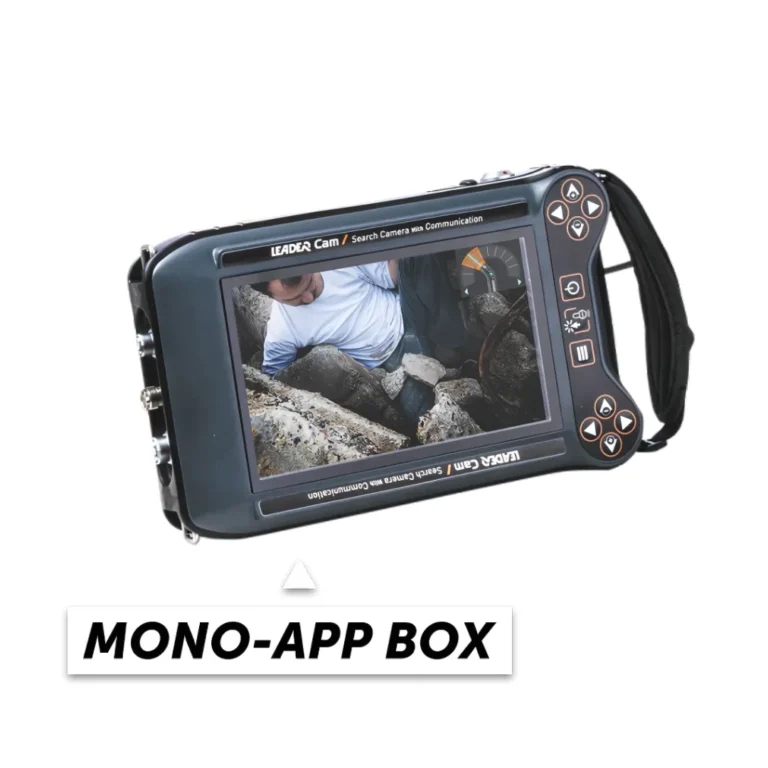
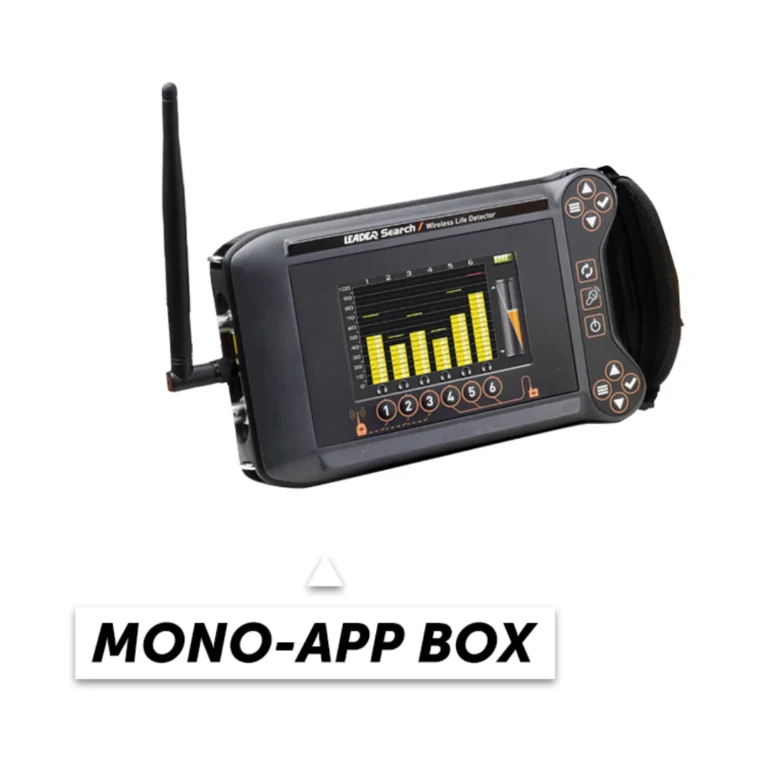
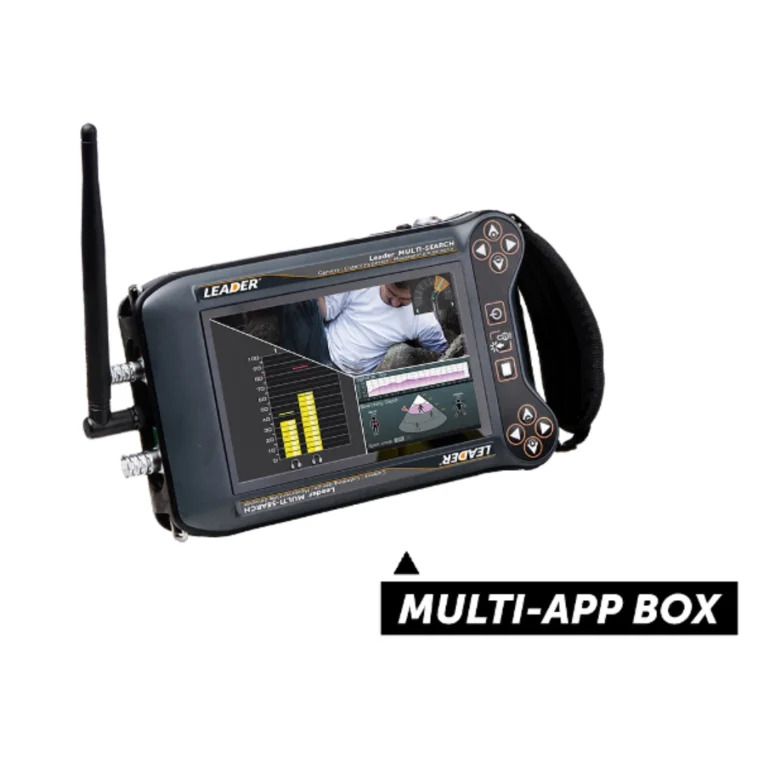
Using a pole or extension lead, the CAM can be connected to MULTI-APP control boxes (LEADER MULTISEARCH, CAM MS, SEARCH MS, HASTY MS and SCAN MS devices) or MONO-APP control boxes (LEADER CAM and HASTY devices).
NAVIGATION INTERFACE DESIGNED FOR VISUAL SEARCHING
Each item has been designed to make rescuers' work easier:
- Compact and lightweight control box,
- Extra-wide colour screen,
- User-friendly graphic interface,
- Intuitive and discreet menu to display the image over the whole screed,
- Digital x2 zoom,
- Screen rotation of the image top (0°), bottom (180°),
- Display of degree of rotation of the camera head,
- Display of light level from LEDs fitted on the camera head,
- Adjustment of audio headset(s) and microphone volume,
- Push-to-Talk (press to talk to the victim with the loudspeaker/microphone on the camera),
- Takes photos,
- Records videos,
- Photo gallery, etc.
The CAM device is a colour search camera head with integrated communication system developed with victim location specialists.
The colour victim location camera is used during rescue and rescue-clearance operations to see and communicate with victims trapped in inaccessible locations up high or in hard-to-reach confined spaces such as wreckage, wells, crevices, caves, etc. It helps to assess their need for assistance and rescue.
It meets operational requirements since many international expert search and rescue teams (INSARAG, Civilian Security, FEMA Task Force, USAR teams, UKSAR, SAR, NGOs, etc.) use LEADER search equipment.
Benefits:
- Can be connected to MONO-APP control boxes (using a single device) or MULTI-APP control boxes (up to 5 devices connected alternately)
- Connection by: 3.7 m telescopic pole; 25 m, 90 m or 2 x 90 m (180 m) extension leads
- Orientation of the camera through 170° with 260° field of view
- Head protected by scratch-resistant sapphire crystal glass
- Flexible camera head joint to cushion impacts
- Waterproof to 2 m once the camera is fitted with the special plug
- Adjustable LED lighting with 8 intensity levels
- Microphone and Loudspeaker integrated into the camera
- 47 mm diameter to pass through 51 mm bore-holes
- Camera position reported on screen
- Waterproof connector once connected to the camera